
Introduction
Legal document templates India free can help individuals, families, freelancers, landlords, tenants, and business owners prepare common legal documents without starting from scratch. These templates provide a basic structure for recording agreements, declaring facts, defining responsibilities, and documenting important transactions.
In India, legal documents are used for many purposes, including rental arrangements, business partnerships, employment, lending money, property transactions, and personal declarations. A suitable template can save time, improve organization, and help users identify the information that needs to be included in a document.
However, not every legal document is valid simply because it follows a template. Requirements may differ depending on the document type, state, transaction value, applicable law, stamp duty, registration requirements, and the circumstances of the parties involved.
This guide explains where to find free legal document templates, which forms are commonly used in India, how to customize them, and what to check before signing or relying on a legal document.
What Are Free Legal Document Templates in India?
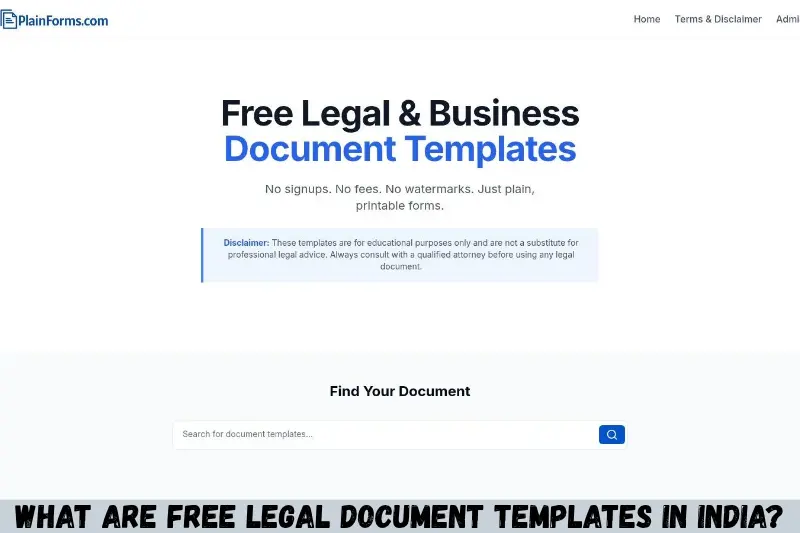
Free legal document templates are preformatted documents that users can download, edit, and adapt for specific legal or administrative purposes. They usually contain standard headings, clauses, blank fields, and signature sections.
For example, a rental agreement template may include the landlord’s and tenant’s details, property address, rent amount, security deposit, duration, and responsibilities of each party.
Instead of creating the document from a blank page, users can fill in the relevant details and review the terms before finalizing it.
What Information Does a Legal Template Usually Include?
Depending on its purpose, a legal document template may contain:
- Full names and contact details of the parties.
- Addresses and identification details where appropriate.
- The purpose of the document.
- Rights, duties, and responsibilities.
- Payment amounts, dates, and deadlines.
- Conditions, limitations, and termination clauses.
- Witness details, signatures, and dates.
- Supporting document references, where necessary.
Not every document requires every item. An affidavit, for example, has different requirements from a commercial contract or a property agreement.
Types of Legal Document Templates India Free Users Commonly Need
The most useful legal templates depend on whether you are handling a personal matter, renting property, managing a business, or recording a financial transaction.
The following are common categories to consider when searching for free legal forms in India.
1. Rental Agreement Template
A rental agreement records the terms between a landlord and a tenant. It can help both parties understand their obligations throughout the tenancy.
A typical rental agreement includes:
- Names and addresses of the landlord and tenant.
- Description and address of the rented property.
- Monthly rent and payment date.
- Security deposit and refund conditions.
- Tenancy duration and renewal terms.
- Maintenance responsibilities.
- Notice period and termination conditions.
- Rules regarding property use and subletting.
Practical example: A tenant renting an apartment in Delhi can use a rental agreement template as a starting point to record the monthly rent, deposit, maintenance arrangements, and agreed tenancy period.
Before using the agreement, check the applicable state requirements, stamp duty, and whether registration is necessary. A template alone does not satisfy every legal formality.
2. Affidavit Template
An affidavit is a written statement of facts that a person formally swears to or affirms, following the applicable legal procedure.
Affidavits may be requested for certain administrative, educational, employment, identity-related, or other official purposes.
An affidavit template may include:
- The name and address of the person making the declaration.
- A suitable title and purpose.
- Numbered statements of fact.
- A verification or declaration section.
- The person’s signature.
- The required attestation or authentication details.
Important: The required format depends on the purpose and the authority requesting the affidavit. Some affidavits must be sworn or affirmed before an authorized official. Simply downloading and signing a template does not automatically make it a valid affidavit.
Use only accurate statements and confirm the required format before submitting it.
3. Employment Agreement Template
An employment agreement outlines the terms governing the relationship between an employer and an employee.
It is useful for documenting expectations and reducing misunderstandings about workplace responsibilities.
Common sections include:
- Employer and employee details.
- Job title and responsibilities.
- Salary and payment schedule.
- Working hours and leave provisions.
- Confidentiality obligations.
- Notice period and termination conditions.
- Intellectual property provisions, where relevant.
- Applicable policies and dispute-related terms.
Practical example: A small company hiring a marketing executive can use an employment agreement template to record the employee’s position, salary, reporting structure, and notice period.
Employment agreements must comply with applicable Indian employment laws and other relevant rules. Review provisions concerning wages, working conditions, confidentiality, and post-employment restrictions before using a template.
4. Business Contract Template
A business contract records the terms of a commercial arrangement between two or more parties.
It may be used by small businesses, consultants, service providers, freelancers, agencies, and suppliers.
A business contract template commonly includes:
- Details of the contracting parties.
- Description of the products or services.
- Deliverables and deadlines.
- Fees, taxes, and payment conditions.
- Confidentiality requirements.
- Ownership of work and intellectual property.
- Termination conditions.
- Dispute resolution and governing law.
Practical example: A freelance web developer can use a service agreement template to describe the website development work, project milestones, payment schedule, revision limits, and ownership of the completed website.
The template should match the actual transaction. High-value projects, complex intellectual property arrangements, and contracts involving significant risks should be reviewed by a qualified legal professional.
5. Loan Agreement Template
A loan agreement records the conditions under which one party lends money to another.
It can help clarify repayment expectations and provide a written record of the transaction.
Typical provisions include:
- Lender and borrower details.
- Principal amount.
- Date the loan is provided.
- Interest rate, if applicable.
- Repayment schedule.
- Late-payment consequences, where lawful.
- Default provisions.
- Signatures and supporting records.
Practical example: If one individual lends money to a friend, a written loan agreement can record the amount, repayment dates, and any agreed interest.
Avoid vague wording such as “repayment will happen soon.” Specific dates and payment terms make the agreement easier to understand.
The enforceability of a loan agreement depends on its terms, applicable law, evidence, and the circumstances of the transaction.
6. Non-Disclosure Agreement (NDA) Template
A non-disclosure agreement is designed to protect confidential information shared between parties.
Businesses and professionals may use NDAs when discussing potential partnerships, sharing product plans, outsourcing work, or evaluating a commercial opportunity.
An NDA template may cover:
- The parties involved.
- The definition of confidential information.
- Permitted uses of the information.
- Restrictions on disclosure.
- Exclusions for information that is already public or independently obtained.
- Duration of confidentiality obligations.
- Permitted disclosures required by law.
- Remedies and dispute-related provisions.
Practical example: A startup discussing a new product with a prospective contractor may use an NDA to establish how confidential technical information can be used and disclosed.
An NDA should not be excessively broad or assume that every type of information can legally be restricted. The wording should reflect the specific relationship and applicable law.
7. Partnership Agreement Template
A partnership agreement records how business partners intend to operate and manage their business relationship.
A well-prepared agreement can reduce confusion about financial contributions, decision-making, responsibilities, and the distribution of profits.
Common provisions include:
- Names of the partners.
- Business name and purpose.
- Capital contributions.
- Profit and loss sharing.
- Roles and responsibilities.
- Authority to make business decisions.
- Accounting and financial records.
- Admission or retirement of partners.
- Dissolution and dispute resolution.
Practical example: Two people starting a small retail business can use a partnership agreement template to document their contributions, management responsibilities, and agreed method of sharing profits.
The parties should ensure that the agreement reflects the applicable requirements of Indian partnership law and any relevant registration or tax obligations.
8. Sale Agreement Template
A sale agreement records the terms under which one party agrees to sell goods or property to another.
The required clauses depend heavily on what is being sold.
For a sale of goods, the document may specify:
- Description and quantity of the goods.
- Price and payment schedule.
- Delivery arrangements.
- Inspection and acceptance conditions.
- Warranties and applicable exclusions.
- Cancellation and dispute terms.
For real estate, additional requirements may apply concerning title, payment milestones, possession, stamp duty, registration, and other property-related formalities.
Important: A general sale agreement template should not be treated as a substitute for a properly prepared property agreement or registered conveyance where the law requires specific formalities.
9. Power of Attorney Template
A power of attorney is a legal instrument through which a person authorizes another person to act on their behalf within the powers specified in the document.
Depending on the circumstances, it may be used for financial, administrative, property-related, or other authorized activities.
A template may identify:
- The person granting the authority.
- The appointed representative.
- The specific powers granted.
- Any limitations on those powers.
- The effective date and duration.
- Revocation provisions, where applicable.
- Execution, witnessing, authentication, or registration requirements.
Power of attorney requirements can vary according to the intended use and applicable law. Property transactions and documents executed for use outside India may involve additional formalities.
Obtain appropriate legal guidance before granting broad authority over financial assets or property.
Where Can You Find Legal Document Templates India Free?
You can begin with official government resources, recognized legal information services, and reputable document providers. The right source depends on whether you need a general template, an official application form, or a document prepared for a specific legal transaction.
1. India Code
India Code is an official government resource for accessing Indian central legislation.
Visit: https://www.indiacode.nic.in/
It is particularly useful when you need to understand the legislation relevant to a document. For example, you can consult applicable laws concerning contracts or partnerships before deciding which clauses your agreement may require.
Best for: Checking legal provisions and understanding the statutory background of a document.
India Code is primarily a legal information resource, not a universal collection of ready-to-sign legal templates.
2. Department and Government Websites
Central and state government departments publish forms for particular administrative procedures, applications, declarations, and official services.
Start at the relevant official department’s website or the National Portal of India:
Check that the form applies to your state, purpose, and current procedure. A form issued by one department may not be accepted by another authority.
Best for: Official applications, prescribed declarations, and department-specific forms.
3. eCourts Services
The Indian judiciary’s eCourts Services portal provides access to court-related information and services.
Visit: https://ecourts.gov.in/
Use official judicial resources to identify relevant court information and procedures. Do not assume that a general internet template is an approved format for filing a particular case.
Best for: Court-related information and understanding where to find relevant judicial services.
4. Reputable Legal Document Providers
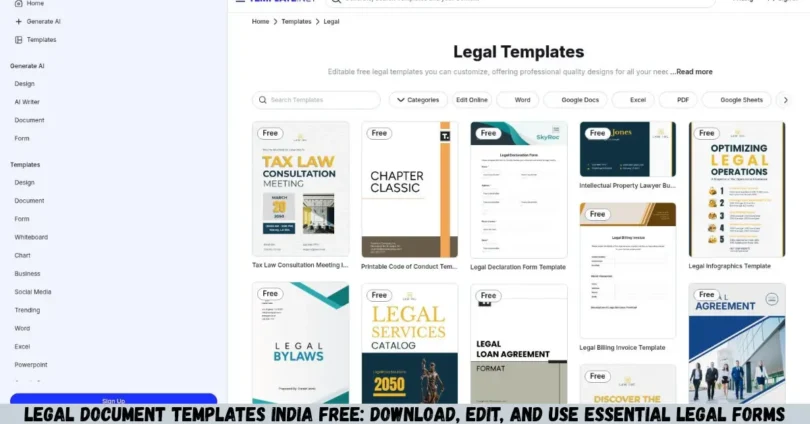
Some legal information platforms and document providers offer downloadable or editable templates for agreements, declarations, and business documents.
Before downloading, review:
- Whether the template is actually free.
- Whether editing or downloading requires payment.
- Whether the document is suitable for Indian law.
- Whether state-specific requirements are addressed.
- When the template was last reviewed or updated.
- Whether the provider explains its limitations.
A document written for the United States, United Kingdom, or another jurisdiction may use unfamiliar legal terminology or clauses that are unsuitable for India.
5. Free Word and PDF Templates
Editable Word documents and printable PDFs can be useful when you need to customize a document yourself.
Word files are generally easier to modify, while PDFs are useful for reviewing and printing a finalized version. Some PDFs are editable, but others are designed only for viewing or printing.
Before relying on a template, verify its source and legal suitability. A professional-looking document is not necessarily legally correct.
Free Legal Templates vs. Paid Legal Document Services
Both free templates and paid legal services can help prepare documents, but they serve different needs.
| Feature | Free legal templates | Paid legal services |
|---|---|---|
| Initial cost | Usually free to download | May involve service or drafting fees |
| Customization | Often completed by the user | May include professional customization |
| Ease of use | Suitable for straightforward documents | Can support more complex requirements |
| Legal review | Not automatically included | May be available, depending on the service |
| State-specific requirements | Must be checked carefully | May be addressed if included in the service |
| Complex transactions | May be insufficient | Can offer tailored drafting and advice |
A free template may be adequate as a starting point for a straightforward document. A customized document may be more appropriate when substantial money, property rights, business liabilities, or complex obligations are involved.
Do not assume that paying for a document automatically guarantees legal validity. Review the provider’s qualifications, scope of service, and terms.
How to Download and Use Legal Document Templates in India
Using a legal template involves more than downloading a file and entering names. You should identify the correct document, customize it accurately, and complete any required legal formalities.
Step 1: Identify Your Legal Requirement
First, decide what you need the document to accomplish.
For example:
- Renting a house requires a document appropriate for the tenancy.
- Lending money may require a written loan agreement.
- Hiring a freelancer may require a service agreement.
- Protecting confidential business information may require an NDA.
Choosing the wrong type of document can leave important issues unaddressed.
Step 2: Select a Reliable Template
Search for the document by its name and intended purpose. Include India or the relevant state in your search when jurisdiction matters.
For example, instead of searching only for “rental agreement template,” search for a rental agreement template suitable for the relevant Indian state.
Prefer templates from credible sources that explain their purpose and limitations.
Step 3: Download the Appropriate File
Choose an editable format if you need to customize the document.
Common formats include:
- DOCX: Useful for editing clauses and filling in details.
- PDF: Useful for reviewing, printing, and sharing a finalized document.
- Online document format: Useful when the provider supports editing through a browser.
Keep an untouched copy of the original template so that you can compare it with your customized version.
Step 4: Enter Accurate Information
Fill in all relevant fields carefully. Check names, addresses, dates, amounts, and other identifying details against reliable records.
Do not leave important blanks that could cause confusion later. If a field does not apply, determine whether it should be removed or marked as not applicable.
Avoid adding unnecessary sensitive personal information.
Step 5: Customize the Clauses
A template is a starting point, not a substitute for considering the actual transaction.
Review the clauses covering payment, deadlines, responsibilities, confidentiality, termination, liability, and dispute resolution.
For example, a freelance agreement should describe the actual deliverables and payment milestones rather than using vague terms such as “work will be completed as agreed.”
Do not copy clauses that you do not understand.
Step 6: Check Stamp Duty and Registration Requirements
Some Indian legal documents may require stamp duty, registration, notarization, witnessing, or other formalities. These requirements depend on the type of document, the applicable law, and the circumstances.
For property documents and other instruments that may require registration, verify the relevant rules with the appropriate state registration authority or a qualified lawyer.
Notarization and registration are different procedures. One does not automatically replace the other.
Step 7: Review, Sign, and Store the Document
Before signing, check the complete document and confirm that all parties agree to the terms.
Depending on the document, execution may require witnesses, stamping, attestation, registration, or other steps.
Once finalized, keep a complete copy with any supporting records, payment receipts, annexures, and proof of execution. Store personal information securely and provide copies only to appropriate recipients.
Are Free Legal Document Templates Legally Valid in India?
Free legal document templates can be used to prepare legally meaningful documents, but their validity depends on the specific document and applicable legal requirements.
There is no universal rule that makes every downloaded template valid or invalid. A document must be evaluated according to its contents, purpose, execution, and the relevant law.
Factors That Can Affect Legal Validity
1. Correct content: The document should accurately record the parties’ intentions and relevant facts.
2. Legal compliance: Its clauses must comply with applicable Indian law.
3. Proper execution: Signatures, witnessing, attestation, or other formalities may be required.
4. Stamp duty: Certain instruments must be appropriately stamped under applicable law.
5. Registration: Some documents must be registered, while others may be registered voluntarily or may follow different rules.
6. Capacity and consent: The parties must have the required legal capacity, and the agreement must satisfy applicable rules concerning consent and enforceability.
7. Document-specific requirements: Particular transactions may have additional conditions that a general template does not cover.
For example, a basic agreement recording the terms of a service arrangement is different from a property instrument that must meet specific stamping and registration requirements.
If you are uncertain about validity, consult a lawyer familiar with the relevant Indian law and state requirements before signing or submitting the document.
Important Indian Legal Requirements to Check
When using legal document templates India free, understanding the legal framework can help you avoid relying on outdated or unsuitable clauses.
Indian Contract Law
The Indian Contract Act, 1872, is an important starting point for understanding contracts in India. It addresses matters including the requirements for agreements to become contracts and the consequences of certain contractual breaches.
Official legislation is available through India Code:
The Act is not the only law that may apply. Specialized legislation and other legal requirements can govern particular transactions.
Stamp Duty
Stamp duty is a tax imposed on specified instruments under applicable stamp legislation. The amount and applicable procedure depend on the instrument, relevant law, and circumstances.
Before executing a document, check the current rules through the appropriate state government or registration department. Do not assume that a document is exempt simply because the template was downloaded for free.
Registration Requirements
Registration may be compulsory for certain instruments, including specified documents relating to immovable property. The applicable requirements depend on the document and relevant legislation.
The Registration Act, 1908, is an important source for understanding registration requirements, although state amendments and other applicable laws may also matter.
Check the current rules with the relevant Sub-Registrar or obtain legal advice when property rights are involved.
Electronic Documents and Signatures
Electronic documents and electronic signatures may be legally recognized in India under applicable law, but not every document or transaction can be completed in the same way.
The Information Technology Act, 2000, provides an important legal framework for electronic records and electronic signatures, subject to its provisions and exclusions.
Confirm whether the specific document can be executed electronically and whether any additional signing, stamping, witnessing, or registration formalities apply.
Benefits of Using Free Legal Document Templates
Free templates offer several practical benefits when used appropriately.
Saves Time
A template provides a starting structure, reducing the effort required to organize headings, clauses, and signature sections.
This is useful for individuals and small businesses preparing straightforward documents.
Reduces Initial Costs
Downloading a free template can eliminate the cost of purchasing a basic document format.
However, free drafting does not eliminate possible stamp duty, registration fees, professional charges, or other transaction expenses.
Improves Organization
Structured templates help users identify key information, including dates, payments, responsibilities, and signatures.
They can also make documents easier to review and compare.
Supports Better Recordkeeping
A written agreement provides a reference for the terms accepted by the parties. It can help clarify expectations and preserve evidence of what was agreed.
The usefulness of that record depends on its accuracy, completeness, and legal status.
Helps Small Businesses Get Started
Freelancers and small businesses can use suitable templates to organize service agreements, confidentiality arrangements, and other routine documentation.
For complex or high-risk transactions, professional review remains important.
Limitations of Free Legal Document Templates
Despite their benefits, free templates have limitations that users should understand.
They May Not Reflect Your Specific Situation
A generic template cannot automatically account for every detail of your transaction.
For example, a standard service agreement may not adequately address intellectual property ownership, complex payment milestones, or industry-specific regulatory obligations.
Some Templates May Be Outdated
Laws, administrative procedures, and official forms can change. A template published several years ago may no longer reflect current requirements.
Check the publication or review date and verify important provisions against official sources.
They May Not Be State-Specific
Stamp duty, registration procedures, and some legal requirements can vary across Indian states.
A template suitable for one location may need modification before it can be used elsewhere.
They May Contain Unclear or Unfair Clauses
Some templates use complicated wording or include clauses that do not reflect the parties’ intentions.
Read every clause before signing. Seek legal advice if the document creates substantial financial obligations or limits important rights.
They Do Not Guarantee a Successful Legal Outcome
Even a carefully drafted agreement cannot guarantee that a dispute will never occur or that every clause will be enforceable.
A template is a drafting aid, not a guarantee of legal protection.
Common Mistakes to Avoid When Using Legal Templates
Avoiding a few common errors can make your documents clearer and more reliable.
Using a Template From the Wrong Country
Legal terminology and requirements differ between jurisdictions. A foreign template may include provisions that are unsuitable for an Indian transaction.
Choose a document designed for India and check whether state-specific rules apply.
Leaving Blank Spaces
Uncompleted fields can create uncertainty or invite later disputes.
Complete all relevant fields and remove unused sections where appropriate. Do not leave material terms unresolved before signing.
Copying Clauses Without Understanding Them
Legal language may affect your rights and obligations in ways that are not immediately obvious.
Understand the meaning and practical consequences of every significant clause before agreeing to it.
Ignoring Stamp Duty or Registration
A signed document may still fail to satisfy applicable formal requirements.
Check the rules before execution, especially for property transactions, certain declarations, and other regulated instruments.
Providing Incorrect Details
Incorrect names, dates, amounts, or addresses can cause confusion and may complicate enforcement or administrative processing.
Proofread the entire document and compare key details with reliable records.
Assuming Notarization Makes Every Document Valid
Notarization does not automatically correct defective terms or replace a registration requirement.
Determine which formalities apply to the specific document rather than assuming that one additional step resolves every legal issue.
Downloading From Unverified Websites
Unreliable websites may provide outdated forms, incomplete clauses, misleading descriptions, or documents designed for another jurisdiction.
Prefer official resources and reputable providers, and avoid submitting personal information to unknown websites without checking their privacy practices.
Tips for Choosing the Right Free Legal Document Template
Use these practical checks before relying on a template.
- Match the document to your purpose: Select a specific agreement or declaration rather than a general form that only partly addresses your needs.
- Check the jurisdiction: Confirm that the template is suitable for India and the relevant state.
- Review the source: Prefer official forms where an authority prescribes a format.
- Check the date: Look for an update or review date and verify current legal requirements.
- Read the entire document: Do not rely solely on its title or introductory description.
- Customize carefully: Ensure that the clauses match the actual agreement.
- Protect personal data: Share only the information required for the document.
- Keep supporting records: Retain signed copies, receipts, annexures, and relevant communications.
- Seek professional advice when needed: Complex transactions and significant financial or property matters deserve additional scrutiny.
A few minutes spent checking these points can help you identify problems before a document is signed or submitted.
Frequently Asked Questions
1. Where can I download legal document templates India free?
You can begin with official government websites, India Code for legislation, relevant state department portals, and reputable legal document providers. Choose the source according to your purpose. Official websites are particularly useful when an authority requires a specific form, while general templates may help with drafting agreements that need further review.
2. Are free legal document templates valid in India?
A free template may be used to prepare a legally meaningful document, but downloading it does not automatically make it valid. The document must satisfy applicable legal requirements, including suitable content, proper execution, and any required stamp duty, registration, witnessing, or attestation. Verify the rules relevant to the particular document before relying on it.
3. Can I edit a legal document template myself?
Yes. You can usually edit an appropriate template in Word or another compatible editor. Enter accurate details, customize the clauses to match the transaction, and remove irrelevant provisions. However, editing a template does not guarantee that the resulting document complies with Indian law. Consider professional review when significant rights, financial obligations, or property interests are involved.
4. Do free rental agreement templates require stamp paper or registration?
The requirements depend on the nature and duration of the tenancy, the applicable law, and relevant state rules. Some rental arrangements require particular stamping or registration formalities, while others may be treated differently. Check the current requirements with the relevant state registration authority or a qualified lawyer before executing the agreement.
5. Should I use a free template or hire a lawyer?
A free template may be a reasonable starting point for a straightforward, low-risk document when you understand the terms and applicable requirements. A lawyer can help with complex agreements, property transactions, substantial loans, business partnerships, and disputed matters. The decision should depend on the potential consequences of errors, the complexity of the transaction, and the legal requirements involved.
Conclusion
Legal document templates India free can help individuals and businesses prepare common agreements, declarations, and other documents more efficiently. Rental agreements, affidavits, employment contracts, loan agreements, NDAs, partnership agreements, and sale-related documents are among the common forms people may need.
The most important step is to choose a suitable template from a trustworthy source and adapt it to your actual requirements. Check the applicable Indian laws, state-specific rules, stamp duty, registration requirements, and execution formalities before signing.