
Introduction
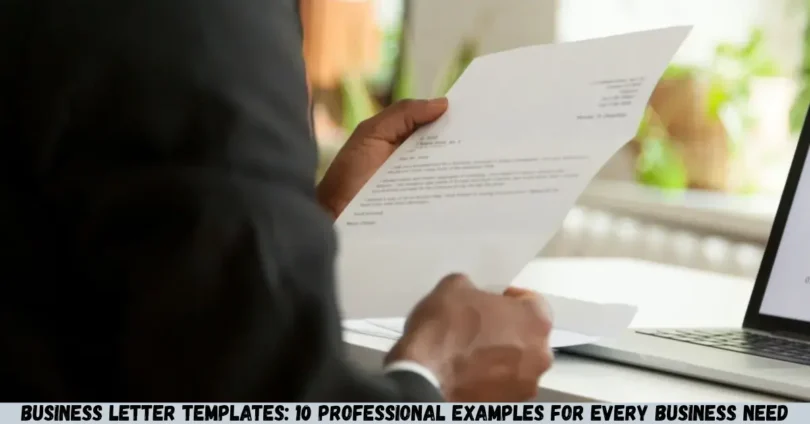
Business letter templates help individuals, employees, entrepreneurs, and business owners write professional letters for different workplace situations. Whether you need to contact a client, apply for a job, request information, submit a complaint, or communicate with a supplier, a well-structured business letter makes your message clear and professional.
A business letter follows a formal structure that usually includes the sender’s information, date, recipient’s details, subject, greeting, body, closing, and signature. Using a suitable template saves time, reduces formatting mistakes, and helps you communicate confidently.
In this guide, you will find useful business letter templates, practical examples, formatting tips, and common mistakes to avoid when writing professional correspondence in India or internationally.
What Are Business Letter Templates?

Business letter templates are ready-made formats that help you prepare formal written communication for professional purposes. They provide a consistent structure that you can customize with your own details, message, and recipient information.
These templates are useful for employees, job seekers, small business owners, managers, freelancers, and organizations.
Common uses include:
- Applying for a job or internship.
- Requesting business information.
- Communicating with customers and suppliers.
- Making a formal complaint.
- Sending quotations or proposals.
- Requesting payment or confirming an order.
- Resigning from a position.
- Following up on meetings or business discussions.
A good template provides a starting point, but you should always adapt the content to your specific situation.
Standard Business Letter Format
A professional business letter should be easy to read, logically organized, and appropriate for its purpose. The standard format below works for many traditional business letters.
- Sender’s details: Include your name, job title, company name, address, email, or phone number as appropriate.
- Date: Write the date of the letter.
- Recipient’s details: Add the recipient’s name, designation, company, and address when needed.
- Subject line: Summarize the purpose of the letter in a few words.
- Salutation: Use a professional greeting, such as Dear Mr. Sharma or Dear Hiring Manager.
- Opening paragraph: Explain why you are writing.
- Main body: Provide the relevant details, request, explanation, or supporting information.
- Closing paragraph: State the expected next step or thank the recipient.
- Formal closing: Use phrases such as Sincerely or Yours faithfully, depending on the context.
- Signature: Add your name and designation, if applicable.
For email correspondence, you can simplify the sender and recipient details because the email system already displays much of this information. Keep the subject line clear and include a professional closing.
10 Business Letter Templates for Different Situations
The following business letter templates cover common professional situations. Replace the information in brackets with your actual details before sending the letter.
1. General Business Letter Template
Use this template when you need to communicate formally with another company, organization, or professional.
Subject: [Purpose of the Letter]
Dear [Recipient’s Name],
I am writing on behalf of [Company Name] regarding [specific purpose]. We would like to discuss [briefly explain the matter] and explore the possibility of working together.
Our organization is interested in [explain the requirement, proposal, or objective]. We believe that clear communication and cooperation can help both parties achieve a positive outcome.
Please let us know a convenient time to discuss this matter further. Thank you for your time and consideration.
Sincerely, [Your Full Name] [Your Designation] [Company Name] [Contact Information]
2. Business Inquiry Letter Template
A business inquiry letter helps you request information about products, services, pricing, delivery schedules, or business opportunities.
Subject: Inquiry About [Product or Service]
Dear [Recipient’s Name],
I am contacting you to request additional information about your [product or service]. We are currently exploring suitable options for [explain your business requirement].
Could you please share your latest pricing, product specifications, payment terms, and delivery options? We would also appreciate receiving any relevant brochures, catalogues, or service details.
We look forward to reviewing your information and discussing the possibility of doing business with your organization.
Thank you for your assistance.
Sincerely, [Your Name] [Company Name] [Contact Information]
3. Business Proposal Letter Template
Use a proposal letter to introduce a business idea, partnership opportunity, project, or professional service.
Subject: Business Proposal for [Project or Partnership]
Dear [Recipient’s Name],
I am writing to propose a potential business collaboration between [Your Company Name] and [Recipient’s Company Name].
Our proposed solution focuses on [describe the product, service, or opportunity]. We believe this collaboration could help address [specific business need] while creating value for both organizations.
We would welcome the opportunity to discuss the proposal in greater detail, including the project scope, estimated costs, timelines, and expected responsibilities.
Please let us know if you would be available for a meeting or call.
Thank you for considering our proposal.
Sincerely, [Your Full Name] [Your Designation] [Company Name]
4. Job Application Letter Template
A job application letter introduces your qualifications and explains why you are interested in a particular position.
Subject: Application for [Job Title]
Dear Hiring Manager,
I am writing to apply for the position of [Job Title] at [Company Name]. My background in [relevant field or skill] and experience with [relevant responsibility] have prepared me to contribute to your team.
In my previous role or academic experience, I developed skills in [mention two or three relevant skills]. I am particularly interested in this opportunity because of its alignment with my professional goals and qualifications.
Please find my resume attached for your consideration. I would appreciate the opportunity to discuss how my experience and skills match your requirements.
Thank you for your time.
Sincerely, [Your Full Name] [Phone Number] [Email Address]
5. Business Complaint Letter Template
A complaint letter formally explains a problem and requests an appropriate resolution. Keep the tone factual and professional, even when the issue has caused inconvenience.
Subject: Formal Complaint Regarding [Product or Service]
Dear [Recipient’s Name],
I am writing to raise a concern regarding [describe the product, service, order, or transaction]. The issue occurred on [date] and relates to [explain the specific problem].
Despite our expectations, [describe what went wrong and include relevant order numbers, dates, or previous communication]. This has resulted in [briefly explain the practical impact].
We request that your team investigate this matter and provide an appropriate resolution, such as [replacement, correction, refund, or another suitable action].
Please respond by [reasonable date, if appropriate] with an update on the steps being taken.
Thank you for your attention to this matter.
Sincerely, [Your Name] [Company Name] [Contact Information]
6. Business Apology Letter Template
A professional apology letter acknowledges a mistake, expresses regret, and explains how the issue will be addressed.
Subject: Apology for [Issue or Inconvenience]
Dear [Recipient’s Name],
We sincerely apologize for [describe the mistake, delay, or service issue]. We understand that this situation may have caused inconvenience, and we regret that your expectations were not met.
The issue occurred because of [brief, accurate explanation, if appropriate]. We are taking steps to address the problem by [describe the corrective action].
We value our professional relationship and appreciate your patience while we work toward a resolution. Please contact us if you require further information or assistance.
Thank you for your understanding.
Sincerely, [Your Full Name] [Your Designation] [Company Name]
7. Business Request Letter Template
A request letter is useful when asking for documents, approval, a meeting, an extension, or other business-related assistance.
Subject: Request for [Specific Requirement]
Dear [Recipient’s Name],
I am writing to request [clearly state the request] in connection with [explain the relevant project, order, or business matter].
The requested information or assistance will help us [explain why it is needed]. If possible, we would appreciate receiving your response by [date] so that we can proceed according to our planned schedule.
Please let me know if you require any additional information or documentation to process this request.
Thank you for your time and cooperation.
Sincerely, [Your Full Name] [Your Designation] [Company Name]
8. Business Follow-Up Letter Template
A follow-up letter helps you maintain communication after a meeting, proposal, quotation, or previous inquiry.
Subject: Follow-Up Regarding [Previous Discussion or Proposal]
Dear [Recipient’s Name],
I hope you are doing well. I am following up on our previous discussion regarding [topic] on [date, if applicable].
We would appreciate an update on the status of [proposal, quotation, request, or project]. Please let us know if you need any additional information from our side to move forward.
We remain interested in discussing the next steps and finding a suitable way to proceed.
Thank you for your time. I look forward to hearing from you.
Best regards, [Your Full Name] [Your Designation] [Company Name]
9. Business Resignation Letter Template
A resignation letter formally communicates an employee’s decision to leave a position. Check your employment agreement and applicable workplace policies for notice requirements.
Subject: Resignation from the Position of [Job Title]
Dear [Manager’s Name],
Please accept this letter as formal notice of my resignation from my position as [Job Title] at [Company Name]. My proposed last working day is [Date], subject to the applicable notice period and company procedures.
I appreciate the opportunities, experience, and professional development I have gained during my time with the organization.
I will do my best to complete pending responsibilities and support a smooth handover of my duties before my departure.
Thank you for your guidance and support. I wish the company continued success.
Sincerely, [Your Full Name] [Job Title] [Department]
10. Business Thank-You Letter Template
A thank-you letter helps maintain positive relationships with clients, suppliers, partners, employees, and other professional contacts.
Subject: Thank You for [Meeting, Support, or Partnership]
Dear [Recipient’s Name],
Thank you for your time and support regarding [specific meeting, project, service, or business activity].
We appreciate your cooperation and the effort you have contributed to [briefly describe the relevant matter]. Your assistance has been valuable in helping us move forward with our plans.
We look forward to maintaining our professional relationship and exploring future opportunities to work together.
Thank you once again for your support.
Best regards, [Your Full Name] [Your Designation] [Company Name]
How to Write a Professional Business Letter
Writing an effective business letter requires a clear purpose, an appropriate tone, and a logical structure. Follow these steps to prepare a letter that communicates your message without unnecessary detail.
Step 1: Identify Your Purpose
Decide what you want the letter to accomplish before you begin writing. For example, you might want to request information, resolve a complaint, submit a proposal, or confirm an agreement.
A clearly defined purpose helps you choose the correct template and keep your message focused.
Step 2: Understand Your Recipient
Consider the recipient’s role, relationship with your organization, and familiarity with the subject. A letter to a potential client may require a more introductory approach than a letter to a supplier you have worked with for years.
Use the recipient’s name and designation when known, and avoid unnecessarily casual language in formal correspondence.
Step 3: Write a Clear Subject Line
A useful subject line tells the recipient what the letter concerns before they read the main message.
Examples include:
- Request for Product Pricing
- Application for Marketing Executive Position
- Complaint Regarding Delayed Delivery
- Proposal for Business Partnership
- Follow-Up on Project Discussion
Avoid vague subjects such as “Important Matter” when a more specific description is possible.
Step 4: Keep the Main Message Focused
Begin with your reason for writing. Use the following paragraphs to explain relevant details, supporting information, and any action you want the recipient to take.
If the letter includes several requests, organize them into separate paragraphs or a short list. This makes it easier for the recipient to understand and respond.
Step 5: Include Accurate Details
Check names, designations, dates, reference numbers, prices, addresses, and contact information before sending the letter. If you mention an attachment, make sure it is actually included.
Accuracy is especially important for purchase orders, quotations, payment requests, contractual communication, and employment-related letters.
Step 6: End with a Clear Next Step
Tell the recipient what should happen next. You might request a reply, ask for a meeting, confirm a deadline, or simply thank them for their consideration.
A clear closing prevents misunderstandings and makes it easier for the recipient to act on your message.
Step 7: Proofread Before Sending
Review your letter for grammar, spelling, punctuation, formatting, and tone. Remove repeated sentences and unnecessary details.
Read the letter from the recipient’s perspective. Ask yourself whether the purpose is clear and whether the requested action is easy to identify.
Benefits of Using Business Letter Templates
Business letter templates provide several practical advantages when used correctly.
- Save time: Start with an established format instead of writing every letter from scratch.
- Maintain consistency: Use a similar structure across client communications, requests, and internal business correspondence.
- Improve clarity: Follow a logical sequence that helps readers understand the message.
- Reduce formatting errors: Use a standard layout for headings, greetings, paragraphs, and signatures.
- Support professional communication: Select wording that fits the situation and the relationship.
- Simplify repeated tasks: Adapt a template for recurring activities such as order confirmations, payment reminders, and follow-ups.
Templates are starting points rather than substitutes for careful writing. A generic letter may sound impersonal or fail to address the recipient’s actual concern if it is not customized.
Business Letter Templates vs. Business Email Templates
Business letters and business emails serve similar communication purposes, but their presentation and level of formality can differ.
| Feature | Business Letter | Business Email |
|---|---|---|
| Format | Traditional formal document | Electronic message |
| Sender details | Often included in the document | Usually shown by the email system |
| Recipient address | Often included in formal letters | Usually entered in the email fields |
| Subject line | Useful for clarity | Essential for organized communication |
| Signature | Written or digital, depending on use | Usually a professional email signature |
| Common uses | Formal notices, official correspondence, applications | Daily communication, inquiries, updates, follow-ups |
Choose the format based on the recipient’s expectations, your organization’s policies, and the importance of the communication. Some formal matters may require a signed document or a prescribed format rather than an ordinary email.
Tips for Using Business Letter Templates Effectively
Small improvements can make your business correspondence more useful and professional.
- Personalize every letter: Replace all placeholders and include details relevant to the recipient.
- Use simple language: Prefer familiar words and direct sentences over complicated expressions.
- Maintain a respectful tone: Be polite and firm when necessary, particularly when making complaints or requesting overdue payments.
- Choose readable formatting: Use a consistent font, clear paragraphs, and appropriate spacing.
- Keep sensitive information secure: Share financial, customer, or employee information only through suitable channels and with authorized recipients.
- Check organizational requirements: Follow company letterhead, branding, approval, and record-keeping procedures where applicable.
- Save reusable versions: Store approved templates with clear filenames so they are easy to locate and update.
For Indian businesses, also confirm whether a specific letter must follow a company’s prescribed format, a government department’s instructions, or the requirements of a particular transaction.
Common Mistakes to Avoid When Writing Business Letters
Even a well-designed template can produce a poor result if it is not used carefully.
Using a Generic Greeting
A greeting that does not fit the recipient can make the letter feel impersonal. Use the person’s name or appropriate designation when available. If the recipient is unknown, a greeting such as “Dear Hiring Manager” may be suitable for a job application.
Writing Long, Unfocused Paragraphs
Too much background information can hide the main message. Include only details that help the recipient understand the situation or decide what to do next.
Forgetting the Purpose of the Letter
Every business letter should have a clear objective. If the reader cannot identify why you are writing, revise the opening paragraph and subject line.
Using an Inappropriate Tone
Aggressive language, slang, or emotional accusations can damage professional relationships. State the facts, explain the issue, and make a reasonable request.
Leaving Placeholder Text in the Final Document
Always search for bracketed fields such as [Recipient’s Name] or [Company Name] before sending. Replace them with accurate details or remove fields that do not apply.
Ignoring Attachments and Supporting Documents
If your letter refers to an invoice, resume, quotation, or report, confirm that the document is attached or included as intended. Check that the recipient has permission to access it.
Frequently Asked Questions
1. What are business letter templates used for?
Business letter templates are used to prepare formal correspondence for professional situations. Common examples include job applications, business inquiries, proposals, complaints, requests, resignations, and thank-you letters. They provide a consistent structure that users can customize, helping them communicate more clearly while saving time on routine writing and formatting.
2. How do I write a simple business letter?
Start with your details and the date, followed by the recipient’s information when appropriate. Add a clear subject line, a professional greeting, and an opening paragraph explaining your purpose. Provide the necessary details, state the next step, and finish with a suitable closing and your name. Proofread everything before sending.
3. Can I use business letter templates for emails?
Yes, most business letter templates can be adapted for professional emails. Keep the subject line, greeting, main message, and closing, but remove traditional address blocks when they are unnecessary. Make sure the email is concise and includes relevant attachments, contact information, and a professional signature when appropriate.
4. What is the best format for a professional business letter?
The full-block format is a common choice because all text begins at the left margin, making the letter easy to read. It typically includes sender and recipient details, the date, a subject, a greeting, the body, a formal closing, and a signature. However, you should follow any specific formatting requirements set by your organization or recipient.
5. Are business letter templates suitable for small businesses in India?
Yes, small businesses in India can use business letter templates for client communication, supplier inquiries, quotations, payment follow-ups, complaints, and other routine tasks. Templates should be adapted to the business relationship and purpose. For legal notices, tax matters, government submissions, or contractual communication, verify any applicable format and professional requirements before sending.
Conclusion
Business letter templates make professional communication easier by providing a reliable structure for common workplace and business situations. From inquiries and proposals to complaints, job applications, and thank-you letters, the right template helps you organize information and communicate your purpose clearly.
To get the best results, choose a template that matches your needs, personalize it with accurate details, maintain a professional tone, and proofread the final document. Start with one of the examples above and adapt it to your next business communication.