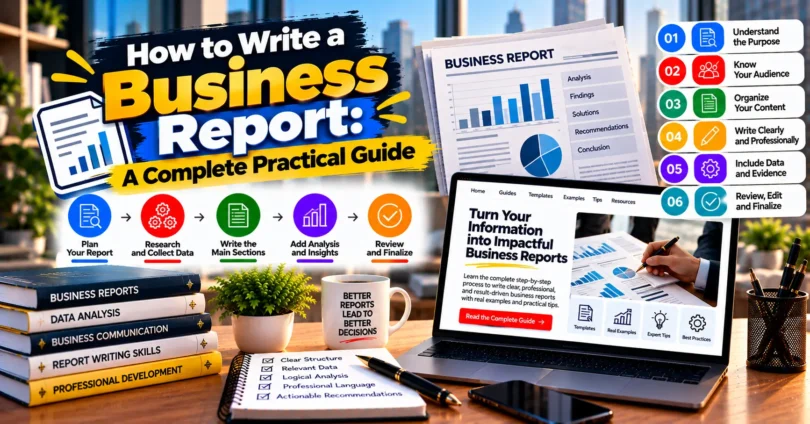

How to write a business report is an important skill for students, managers, entrepreneurs, employees, and business owners who need to communicate facts, findings, and recommendations professionally. A strong business report turns information into a structured document that helps readers understand a situation and make informed decisions.
Unlike an informal email or general article, a business report usually follows a logical structure. It may explain business performance, evaluate a problem, present research findings, compare alternatives, or recommend a course of action.
For professionals and organisations in India, business reports are commonly used for internal reviews, project updates, market analysis, sales performance, financial planning, operational decisions, and management communication.
This guide explains how to write a business report step by step, including its structure, major components, practical examples, benefits, limitations, formatting tips, and common mistakes.
What Is a Business Report?
A business report is a structured document that presents information, analysis, findings, and sometimes recommendations about a specific business issue or objective.
Its primary purpose is to communicate useful information clearly enough for a particular audience to understand the situation and, where necessary, make a decision.
For example, a company experiencing declining sales might prepare a report analysing sales performance, customer behaviour, competition, pricing, and regional trends. The report could then recommend practical actions based on the evidence collected.
Business reports can be short internal documents or detailed formal reports containing multiple sections, charts, tables, appendices, and references.
What Is the Purpose of a Business Report?

The purpose depends on the business problem being addressed. A report may be designed to:
- Present research or business findings
- Analyse performance or operational problems
- Compare different business options
- Record progress on a project
- Evaluate risks and opportunities
- Explain financial or sales results
- Recommend practical actions
- Support management decisions
The best reports have a clearly defined purpose from the beginning. Trying to cover too many unrelated issues usually makes a report less useful.
Common Types of Business Reports
Business reports vary according to their purpose, audience, and level of detail.
Informational Reports
An informational report primarily presents facts without extensive analysis or recommendations.
Examples include monthly sales reports, inventory reports, attendance reports, and project status updates.
Analytical Reports
Analytical reports go beyond presenting information. They examine evidence, identify patterns, compare alternatives, and may recommend a solution.
A market-entry report assessing whether an Indian company should expand into another region is an example.
Research Reports
Research reports communicate the results of structured research. They may contain methodology, data analysis, findings, limitations, and conclusions.
Businesses may use them for customer research, competitor analysis, product development, or market studies.
Progress Reports
A progress report explains how much work has been completed, what remains unfinished, current challenges, and the next steps.
These reports are especially useful for projects involving several teams or stakeholders.
Financial and Performance Reports
These reports communicate financial or operational results using relevant metrics.
Depending on the purpose, they may discuss revenue, expenses, profitability, cash flow, sales performance, productivity, or other key performance indicators (KPIs).
How to Write a Business Report Step by Step
Learning how to write a business report becomes easier when the process is divided into clear stages. Start with the objective, gather reliable information, organise the evidence, and then write for the intended reader.
1. Define the Purpose
Before writing anything, determine exactly why the report is required.
Ask:
- What question should this report answer?
- What problem needs to be examined?
- Who will read it?
- What decision could the report influence?
- What information does the reader actually need?
For example, instead of using a broad objective such as analyse our marketing, define a specific objective:
Evaluate the performance of the company’s digital marketing activities during Q3 and identify areas for improvement.
A precise objective keeps the report focused.
2. Understand Your Audience
A useful business report is written for its intended readers rather than for the writer.
Senior executives may prefer a concise summary, key figures, major risks, and actionable recommendations. Department managers may require more operational detail. Technical teams may need methodology, calculations, or detailed evidence.
Consider the reader’s knowledge, responsibilities, available time, and reason for reading the report.
3. Gather Reliable Information
Collect the evidence required to support the report’s purpose.
Depending on the topic, useful sources can include:
- Internal company records
- Sales and financial data
- Customer surveys
- Interviews
- Market research
- Government publications
- Industry reports
- Project records
- Analytics platforms
- Reputable research publications
For an India-focused report, official information from relevant government ministries, regulators, statistical agencies, or recognised industry bodies may be particularly valuable when applicable.
Always verify important figures before including them.
4. Organise and Analyse the Information
Raw data should not simply be copied into a report. It needs to be organised and interpreted.
Look for patterns, changes, relationships, unusual results, risks, and meaningful comparisons.
Suppose monthly sales increased in Mumbai but declined in another target region. Instead of merely presenting both numbers, investigate possible explanations such as distribution, demand, pricing, competition, seasonality, or campaign performance.
Clearly distinguish between what the evidence shows and your interpretation of why it happened.
5. Create a Clear Report Structure
Planning the structure before drafting saves time and reduces repetition.
A formal business report may include:
- Title page
- Executive summary
- Introduction
- Methodology or approach
- Findings
- Analysis or discussion
- Recommendations
- Conclusion
- References
- Appendices
Not every report requires every section. A short internal performance report, for example, may need only an introduction, findings, recommendations, and conclusion.
Essential Structure of a Business Report
The exact format varies, but several sections appear frequently in professional reports.
Title Page
For a formal report, the title page can include the report title, organisation or department, author, recipient, and submission date.
Keep it simple and professional.
Executive Summary
The executive summary provides a short overview of the report’s purpose, most important findings, and key recommendations.
Although it appears near the beginning, it is usually easier to write after completing the main report.
A busy decision-maker should be able to read the executive summary and understand the central message without reading every supporting detail.
Introduction
The introduction establishes the context.
It should explain the purpose, scope, background, and any important boundaries of the report.
A strong introduction quickly answers: Why does this report exist, and what does it examine?
Methodology
Include a methodology section when readers need to understand how information was collected or analysed.
For example:
The analysis used sales records from April to September, website analytics, customer feedback, and interviews with regional sales managers.
Mention important limitations when they could affect interpretation.
Findings
The findings section presents the important results.
Keep findings factual and logically organised. Use descriptive subheadings and, where appropriate, tables or charts to make complex information easier to understand.
Avoid hiding important results inside long paragraphs.
Analysis and Discussion
This section explains what the findings mean.
Connect evidence to the business objective and discuss patterns, causes, consequences, opportunities, or risks.
Avoid presenting assumptions as proven facts. If several explanations are possible, state that uncertainty clearly.
Recommendations
Recommendations should be specific, realistic, and supported by the report’s findings.
Weak recommendation:
Improve customer service.
Stronger recommendation:
Introduce a standard 24-hour response target for online customer enquiries and review response-time performance monthly.
The second recommendation gives the organisation a clearer action.
Conclusion
The conclusion briefly brings together the most important findings and their implications.
Do not introduce major new evidence here. The conclusion should leave the reader with a clear understanding of the report’s overall message.
Business Report vs Business Proposal
A report and a proposal can look similar, but their primary purposes are different.
| Feature | Business Report | Business Proposal |
|---|---|---|
| Main purpose | Present and analyse information | Persuade readers to approve an idea |
| Focus | Findings, evidence and conclusions | Proposed solution and value |
| Recommendations | May be included | Usually central |
| Typical use | Analysis and decision support | Approval, funding or business opportunity |
| Tone | Objective and evidence-based | Evidence-based but persuasive |
Understanding the distinction helps you choose the correct structure and tone.
Practical Business Report Example
Consider an Indian retail company that wants to understand why online orders are being cancelled.
The report could be organised as follows:
Objective: Identify the main reasons for order cancellations during the previous quarter.
Evidence reviewed: Order records, customer support tickets, delivery data, payment failures, and customer feedback.
Finding: A significant share of cancellations occurs after customers experience delivery-related issues.
Analysis: Delivery delays may be affecting customer confidence and increasing cancellation requests.
Recommendation: Review courier performance by region, establish service benchmarks, and monitor cancellation rates after operational changes.
This example shows an important principle: recommendations should flow from evidence rather than personal opinion.
Benefits of Writing a Good Business Report
A well-prepared report creates a reliable record of business information and makes complex issues easier to evaluate.
Major benefits include clearer communication, better accountability, evidence-based decision-making, improved planning, easier performance monitoring, and stronger coordination between teams.
Reports are particularly valuable when several stakeholders need to work from the same information.
They also create documentation that can be reviewed later when evaluating past decisions.
Limitations of Business Reports
Business reports are useful, but they are not automatically accurate simply because they look professional.
Their quality depends heavily on the quality of the underlying information.
Common limitations include outdated data, incomplete records, limited research samples, biased sources, uncertain forecasts, and assumptions that cannot be fully verified.
A report may also become outdated when market conditions change.
For this reason, important limitations should be disclosed rather than hidden. Transparency helps readers judge how much confidence to place in the conclusions.
How to Make a Business Report More Professional
Professional reporting depends on clarity more than complicated vocabulary.
Keep Sentences Direct
Prefer:
Customer complaints increased during the quarter.
Instead of:
It can be observed that there was an increase in the number of complaints received from customers during the quarter.
Direct language saves the reader time.
Use Headings Strategically
Descriptive headings help readers scan a long report and locate important information quickly.
Instead of using a vague heading such as Results, consider Regional Sales Performance when that more accurately describes the section.
Present Numbers Clearly
Tables work well for exact comparisons, while charts can make trends easier to see.
However, visual elements should have a clear purpose. Avoid adding decorative charts that do not improve understanding.
Maintain a Consistent Format
Use consistent fonts, heading styles, spacing, terminology, date formats, number formats, and table designs.
If the organisation has an established reporting template, follow it.
Separate Facts From Opinions
Professional reports should make it clear whether a statement is based on evidence, interpretation, or a recommendation.
This distinction strengthens credibility.
Common Mistakes to Avoid
Several mistakes can weaken an otherwise useful report.
Writing Without a Clear Objective
Without a defined objective, the document can become a collection of unrelated information.
Define the central question before beginning research.
Adding Too Much Information
More information does not necessarily produce a better report.
Include information that helps answer the report’s main question. Move detailed supporting material to an appendix when appropriate.
Using Unverified Data
Incorrect statistics can damage the credibility of the entire report.
Verify important figures and record where they came from.
Making Unsupported Recommendations
Recommendations should be connected to evidence presented earlier.
Avoid recommending major changes simply because they seem reasonable.
Ignoring Limitations
No dataset or research process is perfect. If an important limitation affects the findings, explain it.
Poor Proofreading
Spelling errors, inconsistent numbers, incorrect labels, and formatting problems can make professional work appear unreliable.
Review the final document carefully before submission.
Final Checklist for a High-Quality Business Report
Before submitting your report, confirm that:
- The purpose is immediately clear.
- The intended audience has been considered.
- Important information comes from reliable sources.
- Facts and interpretations are distinguishable.
- Headings follow a logical order.
- Tables and charts are accurate and necessary.
- Findings answer the original business question.
- Recommendations are practical and evidence-based.
- Important limitations are disclosed.
- Grammar, spelling, numbers, and formatting have been checked.
- The executive summary reflects the completed report.
- Unnecessary repetition has been removed.
A final review from the reader’s perspective can reveal problems that are easy for the writer to miss.
Frequently Asked Questions
1. What is the basic format of a business report?
A business report commonly includes a title, executive summary, introduction, findings, analysis, recommendations, and conclusion. Formal research-based reports may also contain methodology, references, and appendices. The exact format should match the report’s purpose and audience rather than including sections that do not add useful information.
2. How do you start writing a business report?
Start by defining the specific question or objective the report must address. Then identify the intended readers, decide what information they need, and gather reliable evidence. Creating an outline before drafting helps organise findings logically and prevents unrelated information from distracting from the report’s main purpose.
3. How long should a business report be?
There is no universal ideal length. A simple internal update may be only a few pages, while a detailed research or analytical report can be much longer. The report should be long enough to answer its central question properly but concise enough that readers can identify the important findings and actions efficiently.
4. What makes a business report effective?
An effective business report has a clear purpose, reliable evidence, logical organisation, concise writing, transparent limitations, and useful conclusions. When recommendations are included, they should be practical and supported by findings. Effective reports also make important information easy to locate through meaningful headings, summaries, tables, or charts where appropriate.
5. Should a business report include recommendations?
Not always. Informational reports may simply present facts or performance data. Analytical reports often include recommendations because their purpose involves evaluating a problem or supporting a decision. When recommendations are required, each one should connect logically to the evidence and analysis presented in the report rather than relying on unsupported opinion.
Conclusion
Understanding how to write a business report starts with understanding its purpose. A strong report does more than organise information: it converts reliable evidence into clear findings that readers can understand and use.
Begin with a specific objective, identify your audience, gather trustworthy information, analyse the evidence carefully, and organise the document using appropriate sections. Keep the writing concise, separate facts from assumptions, disclose meaningful limitations, and ensure recommendations are supported by findings.
Before submitting your next business report, review it from the reader’s perspective. Ask whether someone unfamiliar with your research can quickly understand the problem, evidence, conclusion, and next action. If the answer is yes, the report is doing its job.