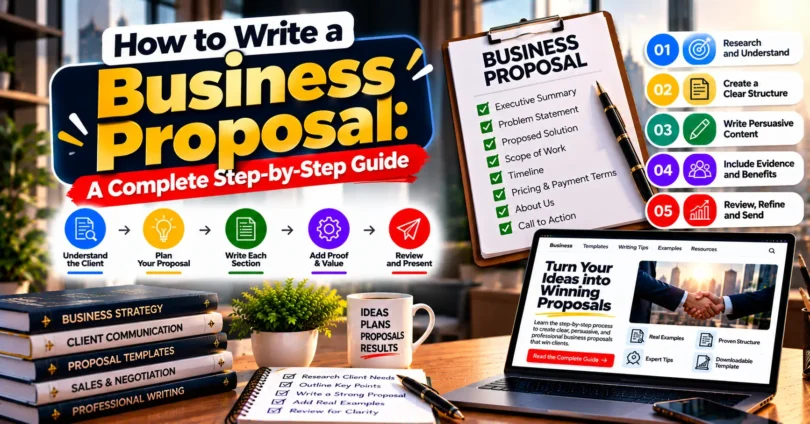

How to write a business proposal is an important question for freelancers, startups, consultants, agencies, and established businesses that want to turn potential opportunities into paying clients. A strong proposal explains a client’s problem, presents your solution, defines the scope of work, and clearly shows why your offer deserves consideration.
A business proposal is more than a document containing prices and services. It is a structured business case designed to help a prospective client make a confident decision.
For businesses in India, proposals are commonly used for consulting projects, digital marketing services, software development, construction contracts, corporate services, vendor partnerships, design work, and B2B sales.
This guide explains how to create a professional business proposal from beginning to end, including its essential sections, practical examples, pricing considerations, common mistakes, and useful writing tips.
What Is a Business Proposal?
A business proposal is a formal document in which a business or professional offers a product, service, solution, or project to a prospective client or organisation.
Its primary purpose is to persuade the recipient that the proposed solution can address a specific requirement or business problem.
For example, imagine a Bengaluru-based retail company wants to increase online sales. A digital marketing agency could prepare a proposal explaining the company’s current challenges, recommended marketing strategy, project deliverables, timeline, fees, and expected business outcomes.
A good proposal answers several important questions:
- What problem does the client have?
- What solution are you recommending?
- Why is your approach suitable?
- What exactly will you deliver?
- How long will the project take?
- How much will it cost?
- What should the client do next?
Answering these questions clearly makes the proposal easier to understand and evaluate.
Business Proposal vs Business Plan

A business proposal and a business plan serve different purposes.
| Business Proposal | Business Plan |
|---|---|
| Usually created for a potential client | Primarily created to describe a business |
| Focuses on a specific solution or opportunity | Covers the broader business strategy |
| Includes scope, deliverables and pricing | Includes operations, market and financial planning |
| Usually supports a sales decision | Often supports management, funding or planning |
| Written around the recipient’s needs | Written around the company’s overall direction |
If your objective is to win a project or sell a service, you generally need a business proposal rather than a complete business plan.
Types of Business Proposals
Business proposals generally fall into two major categories: solicited and unsolicited proposals.
Solicited Business Proposal
A solicited proposal is created because a potential client has requested information or invited businesses to submit proposals.
The request might come through an enquiry, Request for Proposal (RFP), Request for Quotation (RFQ), tender, email, or sales conversation.
Because the client’s requirements are already known, your proposal should directly address those requirements.
Unsolicited Business Proposal
An unsolicited proposal is sent without a formal request from the potential client.
For example, a web development agency may identify a company’s outdated website and propose a redesign.
These proposals require stronger research because the recipient has not specifically asked for your offer.
How to Write a Business Proposal in 9 Steps
The most effective way to write a business proposal is to understand the client’s requirements first and then build every section around those requirements.
Here is a practical process you can follow:
- Research the client and their requirements.
- Create a professional title page.
- Write an executive summary.
- Explain the client’s problem.
- Present your proposed solution.
- Define deliverables and project scope.
- Create a realistic timeline.
- Explain pricing and terms.
- Finish with a clear call to action.
Let’s examine each step.
1. Research the Client Before Writing
Client research is one of the most important parts of proposal preparation. You cannot recommend a convincing solution without understanding the organisation receiving it.
Research the client’s business model, products, customers, industry, competitors, current challenges, and stated project requirements.
If possible, speak directly with the client before preparing the document.
Useful questions include:
- What problem are you trying to solve?
- What outcome would make this project successful?
- What is the expected timeline?
- Who will approve the project?
- Are there specific technical or operational requirements?
- What deliverables are most important?
This information helps you create a customised proposal instead of sending a generic sales document.
2. Create a Professional Title Page
The title page creates the reader’s first impression and should immediately identify the proposal.
Keep it clean rather than filling it with unnecessary information.
A title page can include:
- Proposal title
- Client or company name
- Your business name
- Your logo
- Contact information
- Submission date
- Proposal reference number, if applicable
For example:
Digital Marketing Proposal for ABC Retail Pvt. Ltd.
Prepared by: XYZ Marketing Solutions
Date: 10 October 2026
A simple presentation usually looks more professional than an overcrowded cover.
3. Write a Strong Executive Summary
The executive summary gives decision-makers a quick understanding of your proposal.
It should briefly explain the client’s situation, your recommended solution, major benefits, and the outcome you intend to help achieve.
Avoid turning the executive summary into a long company introduction.
For example:
“ABC Retail wants to strengthen its online customer acquisition and improve the performance of its digital channels. We propose an integrated search, content, and conversion strategy focused on increasing qualified website traffic and turning more visitors into customers.”
Notice that the example begins with the client’s objective rather than talking immediately about the service provider.
That client-focused approach is usually more persuasive.
4. Define the Client’s Problem Clearly
This section demonstrates that you understand why the client needs the project.
Describe the challenge accurately and objectively. Avoid exaggerating weaknesses simply to make your services appear more valuable.
Suppose a business receives website traffic but relatively few enquiries. The proposal might identify issues such as unclear landing-page messaging, weak calls to action, limited search visibility for commercial queries, or an unnecessarily complicated enquiry process.
Specific problems lead naturally to specific solutions.
Why This Section Matters
Clients are more likely to trust a proposal when it reflects their actual situation.
It shows that you have researched the project rather than simply changing the company name inside a standard template.
5. Present Your Proposed Solution
After explaining the problem, describe exactly how you intend to solve it.
This is the core of the proposal.
Instead of writing:
“We will improve your digital presence.”
Use a more concrete explanation:
“We will conduct a technical website review, improve priority service pages, develop a search-focused content plan, and measure qualified leads through agreed conversion events.”
Specific language reduces uncertainty.
Connect Each Solution to a Need
A useful structure is:
Problem → Proposed Action → Intended Outcome
For example:
Problem: Customers struggle to find important services on the website.
Action: Simplify navigation and reorganise key service pages.
Intended outcome: Make important information easier to discover and create a clearer path towards enquiries.
Be careful with guaranteed outcomes. Marketing, sales, SEO, advertising, and similar services involve factors outside the provider’s complete control.
6. Define the Scope and Deliverables
Your scope should explain precisely what the client will receive.
This protects both parties from confusion later.
For a website development project, deliverables might include:
- Website planning and page structure
- Responsive website design
- Development of agreed pages
- Contact form integration
- Basic on-page SEO setup
- Performance testing
- Mobile compatibility testing
- Final launch support
Also state important exclusions where necessary.
For example, if website hosting, paid plugins, copywriting, photography, or ongoing maintenance are not included, say so clearly.
Avoid Scope Creep
Scope creep occurs when additional work is gradually added without adjusting the original budget, timeline, or agreement.
A clear proposal should explain how additional requests will be evaluated and priced.
7. Add a Realistic Project Timeline
A timeline tells the client when major stages and deliverables are expected.
Instead of giving only a final completion date, divide larger projects into phases.
For example:
Week 1: Discovery and research
Week 2: Strategy and planning
Weeks 3–4: Implementation
Week 5: Review and revisions
Week 6: Final delivery
Timelines should be realistic rather than deliberately short just to make a proposal more attractive.
You should also explain dependencies.
If the client must provide approvals, product information, login credentials, images, or feedback, delays in those items may affect delivery.
8. Explain Pricing Clearly
Pricing should be easy to understand.
State what the client is paying, what is included, when payments are due, and whether applicable taxes or third-party costs are included or separate.
A simple pricing section might look like this:
| Service | Fee |
|---|---|
| Research and Strategy | ₹15,000 |
| Website Design | ₹35,000 |
| Development | ₹45,000 |
| Testing and Launch | ₹10,000 |
| Total Project Fee | ₹1,05,000 |
These numbers are only an illustrative example. Actual pricing should be based on project complexity, scope, experience, resources, commercial requirements, and applicable taxes.
Fixed Price vs Hourly Pricing
Fixed pricing works well when the scope is clearly defined.
Hourly or daily pricing can be more suitable when requirements are likely to evolve.
Retainer pricing is commonly used for ongoing services such as marketing, consulting, maintenance, and content production.
Whichever model you choose, explain it clearly.
9. End With a Clear Call to Action
The final section should tell the potential client exactly what happens next.
Do not leave the reader wondering how to proceed.
For example:
“To proceed, please confirm acceptance of the proposed scope and commercial terms. We will then provide the final agreement and schedule the project kickoff.”
You can also include:
- Proposal validity period
- Acceptance process
- Payment requirements
- Contract procedure
- Contact details
- Expected project start process
A clear next step removes unnecessary friction from the buying process.
What Makes a Business Proposal Effective?
An effective business proposal is client-focused, specific, realistic, and easy to evaluate.
The strongest proposals usually share several qualities.
Clear Language
Avoid unnecessary jargon.
The client should understand the proposal even if they do not have specialist knowledge of your industry.
Customisation
Use information relevant to the recipient’s actual business and requirements.
Changing only the client’s name is not meaningful customisation.
Evidence
When appropriate, include relevant case studies, previous experience, portfolio examples, certifications, project methodology, or verifiable results.
Evidence can strengthen credibility, but never invent client results or statistics.
Professional Presentation
Use consistent headings, spacing, typography, branding, and formatting.
A proposal does not need complicated graphics. It needs to be readable.
Realistic Commitments
Promise what you can reasonably deliver.
Overpromising may help attract attention initially, but it can create problems during delivery and damage trust.
Business Proposal Example Structure
If you are wondering how to write a business proposal quickly, use this basic structure:
Title Page
Project title, client, provider, date, and contact information.
Executive Summary
Brief explanation of the client’s objective and your recommended approach.
Problem or Opportunity
A clear description of the requirement you have identified.
Proposed Solution
The strategy or service you recommend.
Scope and Deliverables
Exactly what you will provide.
Methodology
How the project will be completed.
Timeline
Important stages, milestones, and estimated delivery dates.
Pricing
Fees, payment schedule, taxes, and relevant commercial terms.
Why Choose Us
Relevant experience, capabilities, portfolio, or differentiators.
Terms and Conditions
Important responsibilities, limitations, revision terms, confidentiality provisions, or other relevant conditions.
Next Steps
Instructions for accepting the proposal and beginning the project.
You can expand or shorten this structure depending on the size and complexity of the opportunity.
Common Business Proposal Mistakes
Small mistakes can make an otherwise strong proposal less convincing.
Making the Proposal Mostly About Yourself
Clients primarily want to understand what you can do for their business.
Company history can support credibility, but it should not dominate the document.
Sending the Same Proposal to Everyone
Generic proposals often fail to address the client’s priorities.
Personalise the problem, solution, scope, evidence, and expected outcomes.
Hiding the Price
Unless there is a specific reason not to provide pricing, make costs easy to locate and understand.
Confusing commercial information creates unnecessary friction.
Using Vague Deliverables
Terms such as “marketing support” or “complete optimisation” can mean different things to different people.
Define measurable outputs whenever possible.
Guaranteeing Results You Cannot Control
Do not guarantee search rankings, revenue, leads, investment returns, or other outcomes influenced by external factors.
Commit to processes and deliverables that are within your control.
Ignoring Proofreading
Incorrect client names, outdated prices, spelling mistakes, inconsistent numbers, or copied text from another proposal can immediately reduce credibility.
Review the final document carefully before sending it.
Tips for Writing Better Business Proposals in India
Indian businesses range from individual professionals and small local companies to large enterprises, so proposals should reflect the recipient rather than relying on a single style.
First, use INR pricing where appropriate and clearly state whether GST or other applicable charges are included.
Second, understand the client’s decision-making process. A small business owner may approve a project directly, while a larger organisation may require procurement, finance, legal, or departmental approval.
Third, explain payment milestones clearly. For project-based services, payments may be linked to defined stages.
Finally, keep records of approved scope changes. Verbal discussions can be useful, but important commercial changes should be documented.
How Long Should a Business Proposal Be?
There is no universal ideal length. A proposal should be long enough to answer the client’s important questions without unnecessary material.
A straightforward freelance project might require only a few pages, while a complex corporate proposal, tender, technology implementation, or consulting engagement may require substantially more detail.
The complexity and risk of the decision should guide the length.
Focus on completeness rather than page count.
Should You Use a Business Proposal Template?
Yes, a template can save time and improve consistency, but it should be treated as a framework rather than a finished proposal.
Templates are particularly useful for:
- Standard headings
- Branding
- Pricing layouts
- Terms
- Contact details
- Approval sections
Customise the executive summary, client’s problem, solution, deliverables, timeline, and commercial details for every meaningful opportunity.
Benefits of a Well-Written Business Proposal
A professional proposal can improve the sales process in several ways.
It helps you communicate your offer clearly, establish expectations, explain pricing, document project scope, demonstrate professionalism, and give decision-makers information they can share internally.
It can also reduce misunderstandings after the project begins because responsibilities and deliverables have already been documented.
However, even an excellent proposal cannot compensate for an unsuitable offer, unrealistic pricing, poor client fit, or a weak solution.
The proposal supports the sales process; it does not replace business fundamentals.
Frequently Asked Questions
1. What is the best way to start a business proposal?
Start by understanding the client’s problem and desired outcome. After the title page, use a concise executive summary that explains what the client wants to achieve and how your proposed solution addresses that requirement. Avoid beginning with several paragraphs about your own company unless that information is directly relevant to the decision.
2. What should a business proposal include?
A professional business proposal normally includes a title page, executive summary, problem statement, proposed solution, project scope, deliverables, methodology, timeline, pricing, relevant experience, terms, and next steps. The exact structure should depend on the project’s complexity and any requirements provided by the prospective client.
3. How do I make my business proposal stand out?
Research the client carefully and make the proposal specific to their situation. Explain the problem accurately, recommend a practical solution, provide clear deliverables, and support your credibility with relevant evidence. Strong proposals stand out through relevance and clarity rather than exaggerated claims, complicated language, or excessive design.
4. Should I include prices in a business proposal?
In most cases, yes. Pricing helps the prospective client evaluate the complete offer. Clearly explain fees, payment milestones, applicable taxes, optional services, and major third-party costs. If final pricing depends on requirements that have not yet been confirmed, state your assumptions or explain what information is required before providing a final quote.
5. Can I use the same proposal template for every client?
You can reuse the same structural template, branding, standard terms, and certain company information, but important sections should be customised. The client’s problem, objectives, recommended solution, scope, deliverables, timeline, pricing, and relevant examples should reflect the specific opportunity rather than appearing copied from another proposal.
Conclusion
Learning how to write a business proposal becomes much easier when you approach the document from the client’s perspective.
Begin with research, identify the client’s real problem, explain a practical solution, define the scope and deliverables, establish a realistic timeline, present transparent pricing, and finish with a clear next step.
The best proposal is not necessarily the longest or most visually elaborate. It is the one that makes the business decision easier by giving the prospective client clear, relevant, and trustworthy information.
Before sending your next proposal, review it once from the client’s perspective. Ask yourself: Does this document clearly explain my problem, the proposed solution, what I will receive, what it will cost, and what I need to do next?
If the answer is yes, your proposal is ready to move forward.